
The Soul of Old Beijing: A Guide to the Top 10 Hutongs

To truly understand Beijing, you must step into the Hutongs—the narrow, ancient alleys that form the city’s historical framework. For centuries, these lanes have shaped the daily lives of locals and preserved the capital's heritage.
Here is a curated guide to 10 essential Hutongs to explore on your next visit.
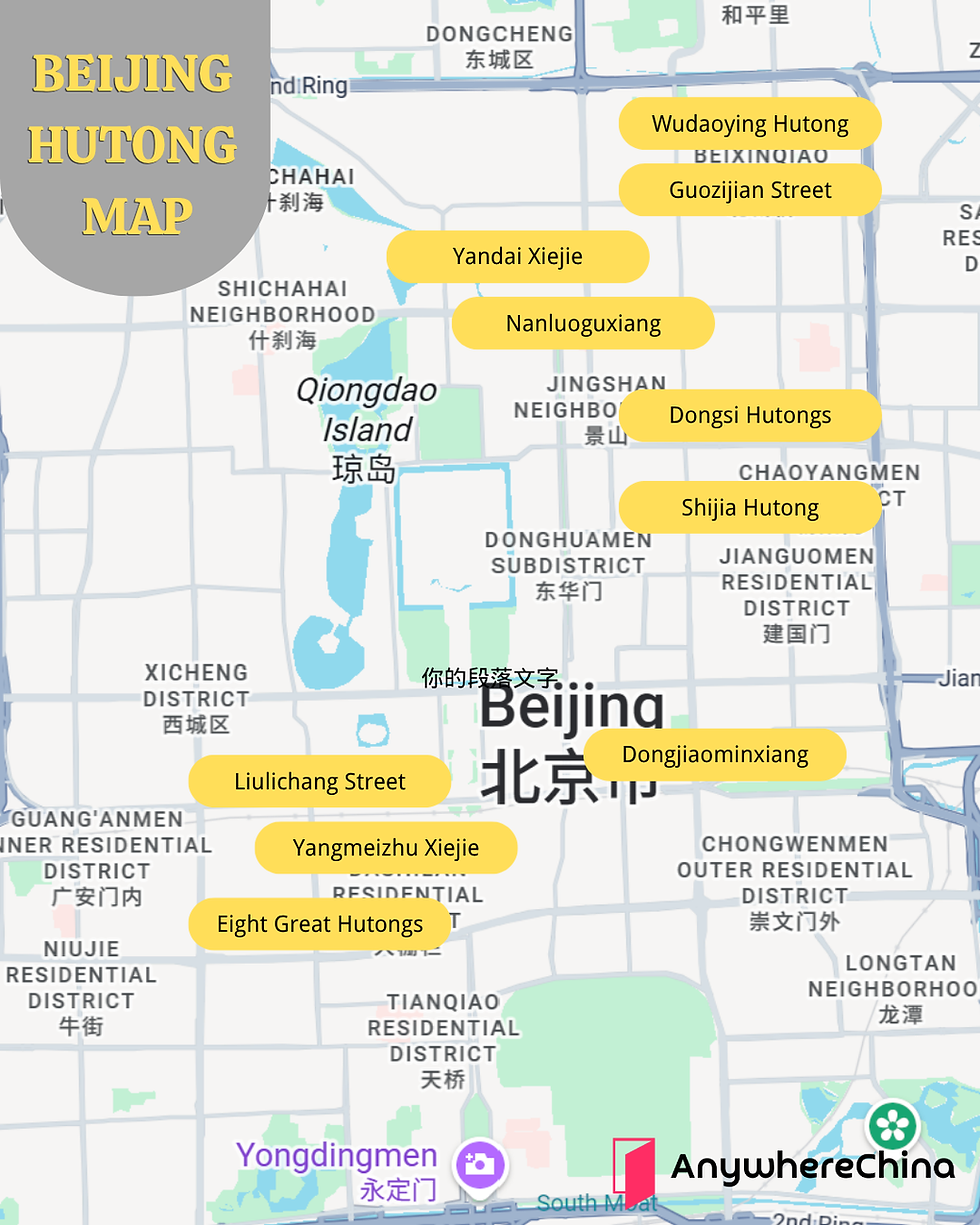
1. Nanluoguxiang (南锣鼓巷) – The Living Chessboard
Dating back to the Yuan Dynasty, Nanluoguxiang is China’s largest and best-preserved traditional residential area built in a "chessboard" layout. Its name, meaning "Saddleback Lane," comes from its unique topography—high in the middle and low at both ends. Once a premier residential district for Ming and Qing dynasty elites, it has housed everyone from imperial generals and princes to presidents and modern literary masters, making it a direct witness to Chinese history.

2. Guozijian Street (国子监街) – The Scholar’s Path
Historically known as "成贤街 (Chengxian Street)" during the Qing Dynasty, this area is the only street in Beijing that retains its four original decorative archways (Paifang). Following the ancient layout of "temple on the left, academy on the right," it houses the Confucius Temple and the Imperial Academy (Guozijian)—the highest institute of learning in imperial China. Today, it remains a popular site for students seeking luck for their exams.

3. Dongjiaominxiang (东交民巷) – A Window to the West
As the longest Hutong in Beijing, Dongjiaominxiang served as the foreign legation quarter during the late Qing Dynasty. This history left the street lined with Western architecture, creating a stark contrast to traditional Beijing. Key landmarks include St. Michael’s Catholic Church, the Beijing Police Museum, the former Yokohama Specie Bank, and the old French Post Office.

4. Liulichang Cultural Street (琉璃厂古文化街) – The Scholar’s Treasure Trove
Named after the glazed tile kiln established here during the Yuan and Ming dynasties, Liulichang transformed during the early Qing Dynasty into a marketplace for antiques, calligraphy, and books. By the Qianlong era, it was the city's primary hub for the "Four Treasures of the Study." Today, historic shops like Huaiyin Shanfang and Ruguzhai maintain a heavy artistic and cultural atmosphere.

5. Bada Hutong (八大胡同) – Tales of Old Dashilar
Located near the Dashilar area outside Qianmen, Bada Hutong (The Eight Great Hutongs) was historically synonymous with Beijing’s red-light district. Beyond the eight primary alleys, nearly a hundred smaller brothels were distributed here, offering a glimpse into the complex social history of old Beijing.

✨ Planning your own Beijing adventure? Every Hutong has a unique history. Let our local experts guide you through the hidden courtyards.
6. Yandai Xiejie (烟袋斜街) – The Tobacco Pipe Lane
This 232-meter diagonal alley connects Dianmen Outer Street to the Shichahai area. During the Qing Dynasty, local Manchu residents developed a strong habit of smoking tobacco, leading to a concentration of pipe shops here. Interestingly, the geographical shape of the alley itself resembles a giant tobacco pipe. Located next to Houhai Lake, it features China's first integrated vintage wine museum and the Qing Post Office. It is highly bustling from 10:00 AM until late evening.

7. Yangmeizhu Xiejie (杨梅竹斜街) – The Creative Heart
Measuring 496 meters long, this diagonal street was originally named after a well-known local matchmaker (Mrs. Yang) in the early Qing Dynasty, before the characters were later elegantized to "Yangmeizhu" (Poplar, Plum, and Bamboo). The street has deep cultural roots and is now home to indie bookstores, traditional publishing houses, Hanfu experience centers, and quiet craft shops like Mofan Bookstore and Qingyun Mansion.

8. Wudaoying Hutong (五道营胡同) – The Quiet Garrison
Known as "武德卫营 (Wudewei Garrison)" in the Ming Dynasty, this alley originally served as a military barracks for troops guarding the city walls. Today, it is a quieter, less commercialized alternative to Nanluoguxiang. The traditional grey-and-black brick walls blend with boutique cafes, making it a peaceful spot for a relaxed afternoon walk.

9. Shijia Hutong (史家胡同) – Half of China's Modern History
There is a common saying in Beijing: "One Shijia Hutong represents half of China’s modern history." Its name stems from the Ming Dynasty patriot Shi Kefa, whose family shrine sat at No. 59 (now Shijia Hutong Primary School). The lane has been home to prominent diplomats, writers, and political figures, and it served as the birthplace of the Beijing People's Art Theatre. It also houses the Shijia Hutong Museum, Beijing’s first dedicated hutong museum.

10. Dongsi Hutongs (东四胡同) – The Imperial Crossroads
Dating back to the Yuan Dynasty, Dongsi was a highly prosperous commercial hub. In the Ming Dynasty, four large archways (Paifang) were built at the intersection, giving the area its famous name, "Dongsi Tailou." At No. 77 Dongsi Sitiao, you will find the Dongsi Hutong Museum. Inside, the "Impression Washe" art installation features tiles made of transparent glass, creating a striking visual blend of ancient architecture and modern design.

🌟 Ready to explore? Book our signature [Beijing Private Tour] to experience the capital with a dedicated, professional concierge-level service. From private courtyard tours to tailored itineraries, we make your China journey seamless.
Our Door-to-Door Private Car Service
Traveling with a baby?
Book our door-to-door premium vans (5-9 seats).
Comes with pre-installed baby seats and a dedicated driver—zero wait, zero language barriers.
Ready to Book?
Leave your need at this link: : https://www.anywherechina.com/custom


Comments